



تكنولوجيا البناء
Palmyra Airport Sheds Its Military Role: A Tourism-Focused Civil Airport Built on Charter Flights
Syria's Civil Aviation Authority will convert Palmyra's military airport into a tourism-focused civil airport built on charter flights: phased rehabilitation, a right-sized passenger terminal, and an initial six-to-twelve-month estimate.
Palmyra — 16 October 2026
Syria’s General Authority of Civil Aviation and Air Transport has announced the conversion of Palmyra’s military airport into an international civil airport dedicated to tourism.
The goal: direct visitor access to the ancient city, a UNESCO World Heritage site, and a direct link to regional and international tourism markets.
What was announced?
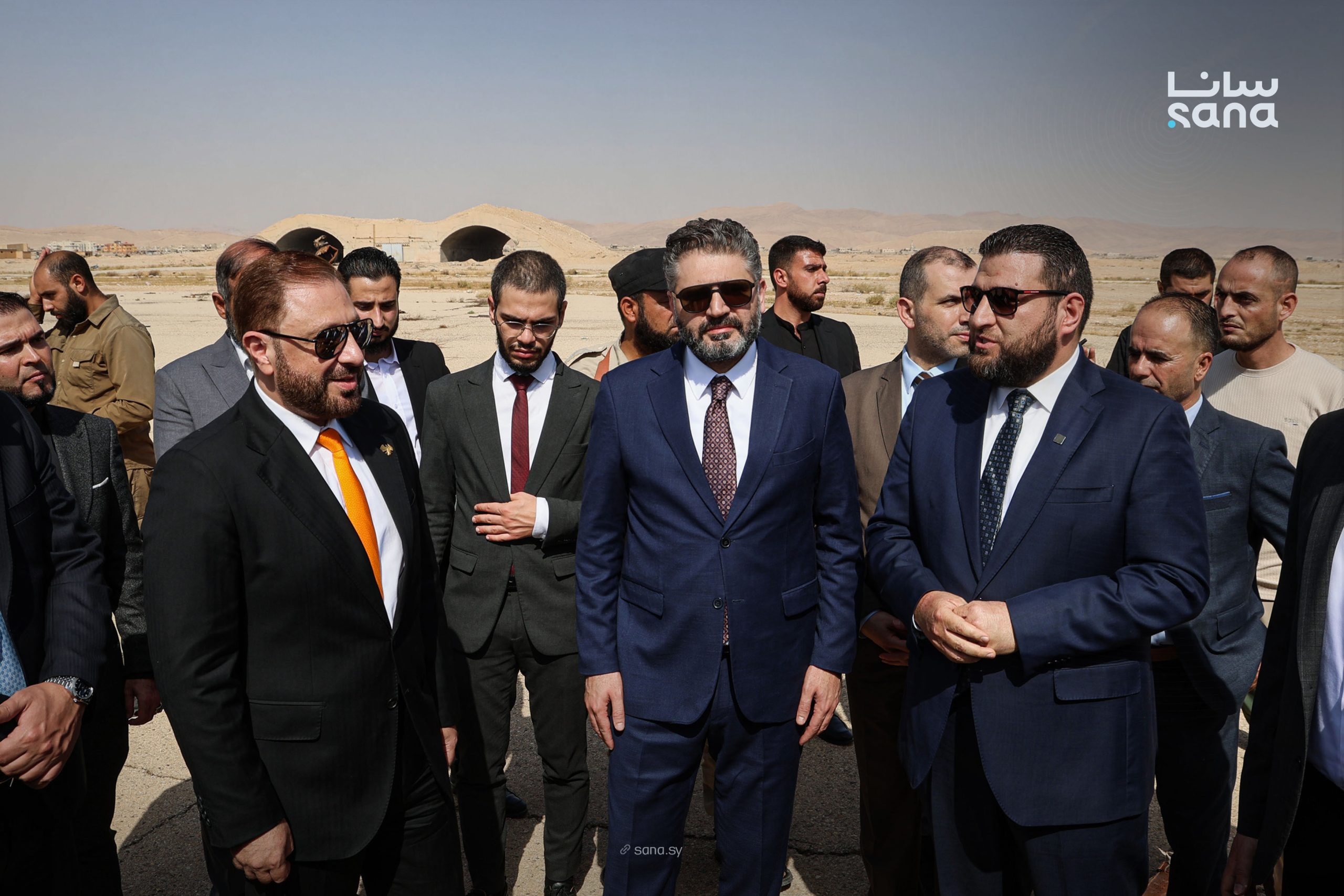
- The announcement was made by the Authority’s president, Omar al-Husri, during a field tour of the airport.
- Taking part in the tour: Tourism Minister Mazen al-Salhani, Culture Minister Mohammad Yassin al-Saleh, and Homs Governor Marhaf al-Nassan.
- The tour’s purpose: inspecting the airport’s condition and defining its rehabilitation requirements.
- Al-Husri denied any current idea of converting another military airport in Homs Governorate into a civil one, for economic feasibility reasons.
The operating model: charter flights first
- A focus on tourist charter flights, rather than necessarily on the scheduled-airline model.
- What is a charter flight? A tour operator or travel agency hires a whole aircraft from an airline for a specific route and date, and sells its seats as part of a complete tourism programme (flight, accommodation, and tours) — not as individual tickets on a regular schedule.
- Airlines and tour operators run direct flights according to tourism programmes and actual demand.
- Tourist groups reach Palmyra without passing through other airports.
- Operating options are open, not limited to specific airlines: they will be studied by feasibility, market, and readiness.
- Flexible operation matched to demand and seasons, with no capacities beyond actual need.
The study and the rehabilitation
- The plan builds on the International Civil Aviation Organization (ICAO) study of 2004, which is being updated.
- The old study is a technical and historical reference only: infrastructure condition, operating requirements, and the market have changed.
- The current study assesses: the condition of the runway, facilities, and equipment — what gets restored and what gets completed.
- It also covers: air navigation, safety, security, and civil operation requirements under current standards.
- In addition to: estimating tourism demand, economic feasibility, and the most suitable operating model.
How will it be executed?
- No new airport from scratch, and no mega-works: restoring the facilities that can be rehabilitated and completing the equipment.
- The announced works: rehabilitating the runways and aprons — repairing damaged parts — designing the airport terminals.
- A tourism passenger terminal with a capacity matched to expected traffic, and no facilities beyond actual need.
- Phased execution following the technical assessment and safety, security, and operating requirements.
- The designs take into account Palmyra’s historical and architectural character.
- The Authority is engaging the companies capable of carrying out the rehabilitation.
The proposed airport’s form: a concept put forward by the magazine
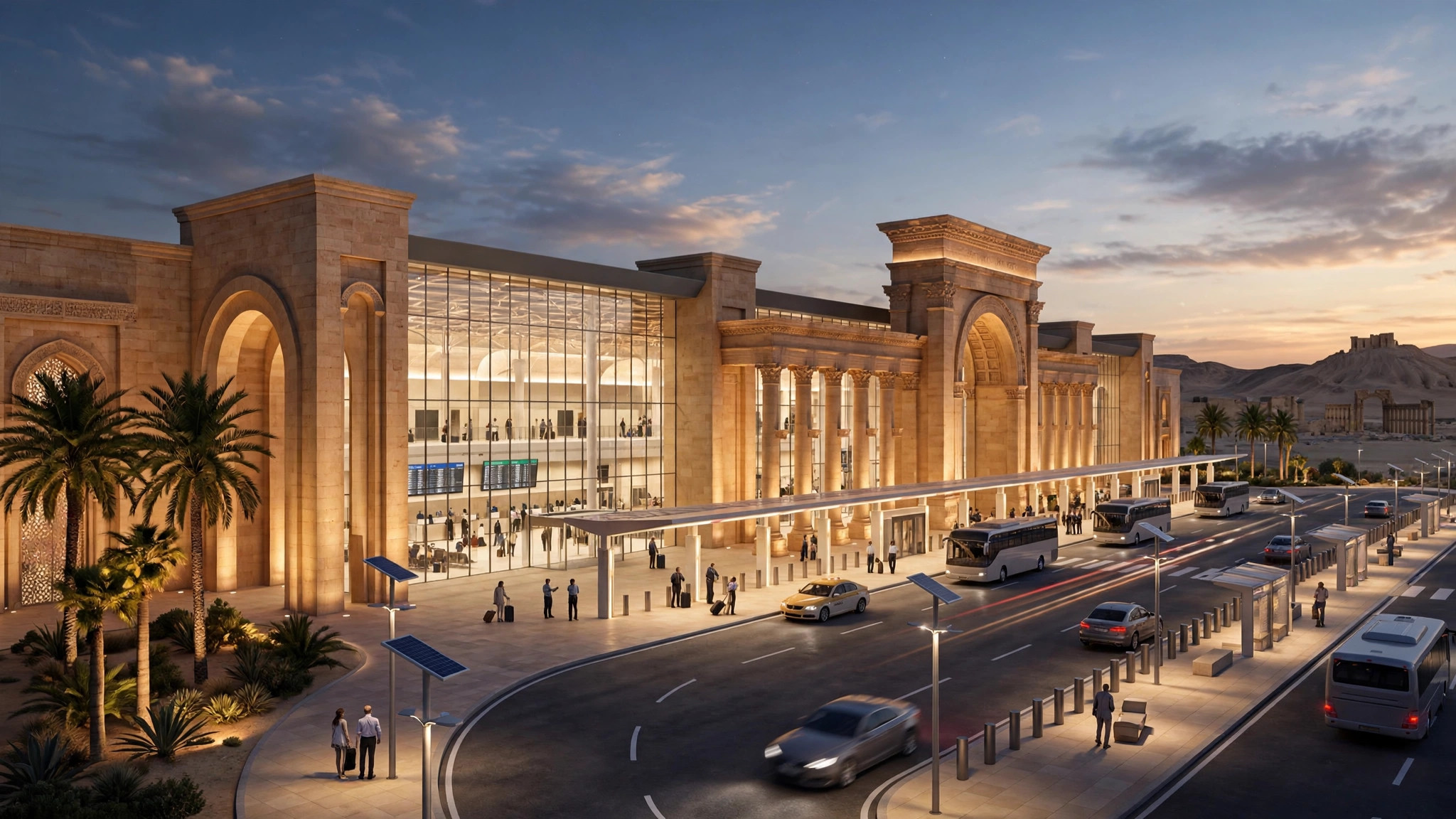
- A clear note: no authority has announced an approved design yet — what follows is a proposed concept by the magazine, not an official design.
- The idea: a passenger terminal in sandstone, with arches and colonnades inspired by classical Palmyrene architecture.
- A wide modern glass facade opening the terminal to the desert light and showing its activity from outside.
- Palms and oasis landscaping at the entrances, and a shaded drop-off area for buses and cars.
- The ruins and the desert as the scene’s natural backdrop, in colours that blend with the place.
- The concept meets what the Authority announced: the designs will take into account Palmyra’s historical and architectural character.
- The final size remains subject to the ongoing study: a terminal sized to demand, no larger.
The timeline
- The initial estimate at the announcement: entry into service between six months and one year.
- International accreditation takes longer: technical and navigational requirements, including navigation aids and radars.
- Al-Husri’s later clarification: the final timeline will be set once the assessment is complete and the works are inventoried.
- And talking about specific figures is still premature, before the demand and feasibility studies.
The existing airport in figures
- IATA code: PMS
- ICAO code: OSPR
- Runway: 08/26 — 2,880 metres × 45 metres — asphalt
- Elevation: 403 metres above sea level
(Existing airport data — source: DAFIF)
The airport alone is not enough
- The project complements Syria’s airport network: an additional direct gateway for tourists to Palmyra.
- Its value is not measured by passenger numbers alone: activation of tourism, investment, services, and jobs in Palmyra and its surroundings.
- The extended city tour included a survey of damage to hotels and accommodation facilities, to schedule their restoration.
- It also included inspecting damaged archaeological sites and preparing them for visitors.
- Tourism Minister Mazen al-Salhani: work on the whole tourism experience at once — the airport, the hotels, the archaeological sites, and basic services.
- The stated goal: preparing the city to receive visitors by next season.
What this means for construction and investment
- Announced, specific work packages: rehabilitating a runway and aprons, repairing damaged facilities, a passenger terminal with a studied capacity, navigation, safety, and security equipment.
- In parallel: rehabilitating damaged hotels and accommodation facilities and raising the readiness of basic services in the city.
- The project’s value lies in its realism, not its scale: existing infrastructure restored, capacity built to the size of demand, a schedule fixed by a documented assessment.
- That is precisely the formula that can be executed and financed.
Sources
- Syrian Arab News Agency (SANA) — https://sana.sy/governorates/homs/2606980/
- Al-Ikhbariah (statements by Authority president Omar al-Husri) — https://alikhbariah.com/رحلات-عارضة-وصالة-ركاب-سياحية-الطيران/
- Al Jazeera — https://www.aljazeera.net/news/2026/10/13/متخصص-بالسياحة-خطة-حكومية-لتحويل
- Enab Baladi (Tourism Ministry statement and the city tour) — https://english.enabbaladi.net/archives/2026/10/syria-plans-palmyra-revival-to-create-jobs-and-investment/
- Existing airport data: DAFIF — https://en.wikipedia.org/wiki/Palmyra_Airport
Prepared by: Construction & Investment Prime Magazine, Syria (CIP)
www.cip.sy | All rights reserved 2026
Follow Construction & Investment Prime
Subscribe to receive the latest articles, real estate and investment projects in Syria
Subscribe Now