



A step toward resuming oil activity: Gulfsands invites drilling contractors for five wells in Block 26 in 2027
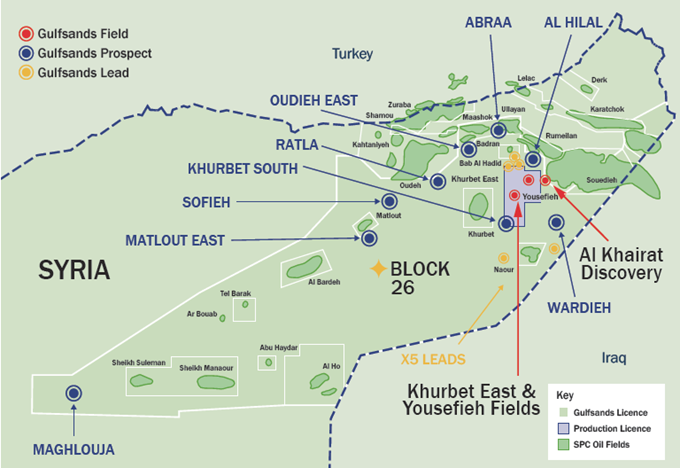
In a fresh step toward resuming oil activity in northeast Syria, Gulfsands, in partnership with Dijla Petroleum, has invited drilling contractors to express interest in a five-well drilling campaign in Block 26. The campaign will be executed on a lump-sum turnkey basis, with drilling targeted to start in the second quarter of 2027, subject to approvals, award and readiness.

In a fresh step toward resuming oil activity in northeast Syria, Gulfsands, in partnership with Dijla Petroleum, has invited drilling contractors to express interest in a five-well drilling campaign in Block 26. The campaign will be executed on a lump-sum turnkey basis, with drilling targeted to start in the second quarter of 2027, subject to approvals, award and readiness.
Gulfsands holds 50% of the Block 26 production-sharing contract and operates it, while China’s Sinopec holds the remaining share. Dijla Petroleum is the joint operating company for the Khirbet East, Yusufiyah and Al-Khairat fields, whose reconstituted board met in Damascus on 23 April 2026 with representatives of the Syrian Petroleum Company, Gulfsands and Sinopec.
What exactly is asked of contractors?
Interested companies should send to gulfsands.drilling@gulfsands.com a company profile, rig availability and location, mobilisation time, readiness to work in Syria, and a contact point. Gulfsands and Dijla will meet contractors during the Abu Dhabi International Petroleum Exhibition and Conference (ADIPEC) in Abu Dhabi from 2 to 5 November 2026.
An important note for contractors: the current announcement is only a preliminary market sounding, not a call for prices nor a prequalification, and expressing interest does not guarantee award.
Why does Gulfsands’ presence matter for Syria?
It is not new to the field — it is its original operator: it discovered the Khirbet East field in 2008 and Yusufiyah in 2010 and developed them until their combined production reached nearly 25,000 barrels of oil per day shortly before December 2011, before its operations stopped in December 2011 with the European Union sanctions, for more than 14 years, while keeping an office in Damascus throughout that period.
The company returned to work in Block 26 during the first half of 2026, after the broad lifting of international sanctions during 2025, the Syrian Petroleum Company’s takeover of the Khirbet East and Yusufiyah fields in late February and early March 2026, and a joint visit by a Syrian Petroleum Company–Gulfsands delegation to the two fields on 10 March 2026, the first in more than 14 years.
The new campaign is the development of known producing fields, not exploration drilling from scratch. The company estimates that existing discoveries alone could produce around 50,000 barrels of oil equivalent per day in the near term, and more than 100,000 barrels per day at full development of the block, while its net proven probable (2C) reserves stand at 78.5 million barrels of oil equivalent as of 1 May 2026, according to its figures. The return of drilling opens contracts for Syrian and regional drilling, services and logistics companies.
Timeline: from discovery to the new drilling
- 2008: Khirbet East field discovered
- 2010: Yusufiyah field discovered
- 2011: Combined production of nearly 25,000 barrels per day, then operations stopped in December 2011
- 2025: Broad lifting of international sanctions; Syrian Petroleum Company established in October
- February–March 2026: Syrian Petroleum Company takes over the Khirbet East and Yusufiyah fields
- 10 March 2026: Joint field visit, the first in more than 14 years
- 23 April 2026: Reconstituted Dijla board meets in Damascus
- 2–5 November 2026: Contractor meetings at the Abu Dhabi International Petroleum Exhibition and Conference (ADIPEC) in Abu Dhabi
- Second quarter 2027: Targeted drilling start (subject to approvals, award and readiness)
In figures:
- 5 wells in the new drilling campaign
- 50% Gulfsands share of the production-sharing contract (Sinopec 50%)
- Nearly 25,000 barrels per day: combined production of the two fields in 2011 before the stoppage
- 78.5 million barrels of oil equivalent: the company’s net (2C) reserves as of 1 May 2026
- 50,000 barrels of oil equivalent per day: potential production from existing discoveries in the near term (company estimate)
- 100,000 barrels of oil equivalent per day: potential production at full development of the block (company estimate)
- Second quarter 2027: targeted drilling start
Read next: